
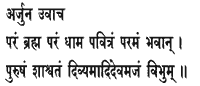
Arjuna said: Thou art the supreme Brahman, the supreme Abode, the supreme Purity, the one permanent, the divine Purusha, the original Godhead, the Unborn, the all-pervading Lord.
The Divine Birth and Divine Works
Sri Aurobindo
THE WORK for which the Avatar descends has like his birth a double sense and a double form. It has an outward side of the divine force acting upon the external world in order to maintain there and to reshape the divine law by which the Godward effort of humanity is kept from decisive retrogression and instead decisively carried forward in spite of the rule of action and reaction, the rhythm of advance and relapse by which Nature proceeds. It has an inward side of the divine force of the Godward consciousness acting upon the soul of the individual and the soul of the race, so that it may receive new forms of revelation of the Divine in man and may be sustained, renewed and enriched in its power of upward self-unfolding. The Avatar does not descend merely for a great outward action, as the pragmatic sense in humanity is too often tempted to suppose. Action and event have no value in themselves, but only take their value from the force which they represent and the idea which they symbolise and which the force is there to serve. The crisis in which the Avatar appears, though apparent to the outward eye only as a crisis of events and great material changes, is always in its source and real meaning a crisis in the consciousness of humanity when it has to undergo some grand modification and effect some new development. For this action of change a divine force is needed; but the force varies always according to the power of consciousness which it embodies; hence the necessity of a divine consciousness manifesting in the mind and soul of humanity.Where, indeed, the change is mainly intellectual and practical, the intervention of the Avatar is not needed; there is a great uplifting of consciousness, a great manifestation of power in which men are for the time being exalted above their normal selves, and this surge of consciousness and power finds its wave-crests in certain exceptional individuals, vibhu¯ tis, whose action leading the general action is sufficient for the change intended. The Reformation in Europe and the French Revolution were crises of this character; they were not great spiritual events, but intellectual and practical changes, one in religious, the other in social and political ideas, forms and motives, and the modification of the general consciousness brought about was a mental and dynamic, but not a spiritual modification. But when the crisis has a spiritual seed or intention, then a complete or a partial manifestation of the God-consciousness in a human mind and soul comes as its originator or leader. That is the Avatar. The outward action of the Avatar is described in the Gita as the restoration of the Dharma; when from age to age the Dharma fades, languishes, loses force and its opposite arises, strong and oppressive, then the Avatar comes and raises it again to power; and as these things in idea are always represented by things in action and by human beings who obey their impulsion, his mission is, in its most human and outward terms, to relieve the seekers of the Dharma who are oppressed by the reign of the reactionary darkness and to destroy the wrong-doers who seek to maintain the denial of the Dharma. But the language used can easily be given a poor and insufficient connotation which would deprive Avatarhood of all its spiritual depth of meaning. Dharma is a word which has an ethical and practical, a natural and philosophical and a religious and spiritual significance, and it may be used in any of these senses exclusive of the others, in a purely ethical, a purely philosophical or a purely religious sense. Ethically it means the law of righteousness, the moral rule of conduct, or in a still more outward and practical significance social and political justice, or even simply the observation of the social law. If used in this sense we shall have to understand that when unrighteousness, injustice and oppression prevail, the Avatar descends to deliver the good and destroy the wicked, to break down injustice and oppression and restore the ethical balance of mankind. Thus the popular and mythical account of the Krishna avatar is that the unrighteousness of the Kurus as incarnated in Duryodhana and his brothers became so great a burden to the earth that she had to call upon God to descend and lighten her load; accordingly Vishnu incarnated as Krishna, delivered the oppressed Pandavas and destroyed the unjust Kauravas. A similar account is given of the descent of the previous Vishnu avatars, of Rama to destroy the unrighteous oppression of Ravana, of Parashurama to destroy the unrighteous license of the military and princely caste, the Kshatriyas, of the dwarf Vamana to destroy the rule of the Titan Bali. But obviously the purely practical, ethical or social and political mission of the Avatar which is thus thrown into popular and mythical form, does not give a right account of the phenomenon of Avatarhood. It does not cover its spiritual sense, and if this outward utility were all, we should have to exclude Buddha and Christ whose mission was not at all to destroy evil-doers and deliver the good, but to bring to all men a new spiritual message and a new law of divine growth and spiritual realisation. On the other hand, if we give to the word dharma only its religious sense, in which it means a law of religious and spiritual life, we shall indeed get to the kernel of the matter, but we shall be in danger of excluding a most important part of the work done by the Avatar. Always we see in the history of the divine incarnations the double work, and inevitably, because the Avatar takes up the workings of God in human life, the way of the divineWill andWisdom in the world, and that always fulfils itself externally as well as internally, by inner progress in the soul and by an outer change in the life. The Avatar may descend as a great spiritual teacher and saviour, the Christ, the Buddha, but always his work leads, after he has finished his earthly manifestation, to a profound and powerful change not only in the ethical, but in the social and outward life and ideals of the race. He may, on the other hand, descend as an incarnation of the divine life, the divine personality and power in its characteristic action, for a mission ostensibly social, ethical and political, as is represented in the story of Rama or Krishna; but always then this descent becomes in the soul of the race a permanent power for the inner living and the spiritual rebirth. It is indeed curious to note that the permanent, vital, universal effect of Buddhism and Christianity has been the force of their ethical, social and practical ideals and their influence even on the men and the ages which have rejected their religious and spiritual beliefs, forms and disciplines; later Hinduism which rejected Buddha, his san˙ gha and his dharma, bears the ineffaceable imprint of the social and ethical influence of Buddhism and its effect on the ideas and the life of the race, while in modern Europe, Christian only in name, humanitarianism is the translation into the ethical and social sphere and the aspiration to liberty, equality and fraternity the translation into the social and political sphere of the spiritual truths of Christianity, the latter especially being effected by men who aggressively rejected the Christian religion and spiritual discipline and by an age which in its intellectual effort of emancipation tried to get rid of Christianity as a creed. On the other hand the life of Rama and Krishna belongs to the prehistoric past which has come down only in poetry and legend and may even be regarded as myths; but it is quite immaterial whether we regard them as myths or historical facts, because their permanent truth and value lie in their persistence as a spiritual form, presence, influence in the inner consciousness of the race and the life of the human soul. Avatarhood is a fact of divine life and consciousness which may realise itself in an outward action, but must persist, when that action is over and has done its work, in a spiritual influence; or may realise itself in a spiritual influence and teaching, but must then have its permanent effect, even when the new religion or discipline is exhausted, in the thought, temperament and outward life of mankind. We must then, in order to understand the Gita’s description of the work of the Avatar, take the idea of the Dharma in its fullest, deepest and largest conception, as the inner and the outer law by which the divineWill andWisdom work out the spiritual evolution of mankind and its circumstances and results in the life of the race. Dharma in the Indian conception is not merely the good, the right, morality and justice, ethics; it is the whole government of all the relations of man with other beings, with Nature, with God, considered from the point of view of a divine principle working itself out in forms and laws of action, forms of the inner and the outer life, orderings of relations of every kind in the world. Dharma1 is both that which we hold to and that which holds together our inner and outer activities. In its primary sense it means a fundamental law of our nature which secretly conditions all our activities, and in this sense each being, type, species, individual, group has its own dharma. Secondly, there is the divine nature which has to develop and manifest in us, and in this sense dharma is the law of the inner workings by which that grows in our being. Thirdly, there is the law by which we govern our outgoing thought and action and our relations with each other so as to help best both our own growth and that of the human race towards the divine ideal. Dharma is generally spoken of as something eternal and unchanging, and so it is in the fundamental principle, in the ideal, but in its forms it is continually changing and evolving, because man does not already possess the ideal or live in it, but aspires more or less perfectly towards it, is growing towards its knowledge and practice. And in this growth dharma is all that helps us to grow into the divine purity, largeness, light, freedom, power, strength, joy, love, good, unity, beauty, and against it stands its shadow and denial, all that resists its growth and has not undergone its law, all that has not yielded up and does not will to yield up its secret of divine values, but presents a front of perversion and contradiction, of impurity, narrowness, bondage, darkness, weakness, vileness, discord and suffering and division, and the hideous and the crude, all that man has to leave behind in his progress. This is the adharma, notdharma, which strives with and seeks to overcome the dharma, to draw backward and downward, the reactionary force which makes for evil, ignorance and darkness. Between the two there is perpetual battle and struggle, oscillation of victory and defeat in which sometimes the upward and sometimes the downward forces prevail. This has been typified in the Vedic image of the struggle between the divine and the Titanic powers, the sons
of the Light and the undivided Infinity and the children of the Darkness and Division, in Zoroastrianism by Ahuramazda and Ahriman, and in later religions in the contest between God and his angels and Satan or Iblis and his demons for the possession of human life and the human soul. It is these things that condition and determine the work of the Avatar. In the Buddhistic formula the disciple takes refuge from all that opposes his liberation in three powers, the dharma, the san˙ gha, the Buddha. So in Christianity we have the law of Christian living, the Church and the Christ. These three are always the necessary elements of the work of the Avatar. He gives a dharma, a law of self-discipline by which to grow out of the lower into the higher life and which necessarily includes a rule of action and of relations with our fellowmen and other beings, endeavour in the eightfold path or the law of faith, love and purity or any other such revelation of the nature of the divine in life. Then because every tendency in man has its collective as well as its individual aspect, because those who follow one way are naturally drawn together into spiritual companionship and unity, he establishes the san˙ gha, the fellowship and union of those whom his personality and his teaching unite. In Vaishnavism there is the same trio, bh¯agavata, bhakta, bhagav¯an,—the bh¯agavata, which is the law of the Vaishnava dispensation of adoration and love, the bhakta representing the fellowship of those in whom that law is manifest, bhagav¯an, the divine Lover and Beloved in whose being and nature the divine law of love is founded and fulfils itself. The Avatar represents this third element, the divine personality, nature and being who is the soul of the dharma and the san˙ gha, informs them with himself, keeps them living and draws men towards the felicity and the liberation. In the teaching of the Gita, which is more catholic and complex than other specialised teachings and disciplines, these things assume a larger meaning. For the unity here is the allembracing Vedantic unity by which the soul sees all in itself and itself in all and makes itself one with all beings. The dharma is therefore the taking up of all human relations into a higher divine meaning; starting from the established ethical, social and religious rule which binds together the whole community in which the God-seeker lives, it lifts it up by informing it with the Brahmic consciousness; the law it gives is the law of oneness, of equality, of liberated, desireless, God-governed action, of God-knowledge and self-knowledge enlightening and drawing to itself all the nature and all the action, drawing it towards divine being and divine consciousness, and of God-love as the supreme power and crown of the knowledge and the action. The idea of companionship and mutual aid in God-love and God-seeking which is at the basis of the idea of the san˙ gha or divine fellowship, is brought in when the Gita speaks of the seeking of God through love and adoration, but the real san˙ gha of this teaching is all humanity. The whole world is moving towards this dharma, each man according to his capacity,—“it is my path that men follow in every way,”—and the God-seeker, making himself one with all, making their joy and sorrow and all their life his own, the liberated made already one self with all beings, lives in the life of humanity, lives for the one Self in humanity, for God in all beings, acts for lokasan˙ graha, for the maintaining of all in their dharma and the Dharma, for the maintenance of their growth in all its stages and in all its paths towards the Divine. For the Avatar here, though he is manifest in the name and form of Krishna, lays no exclusive stress on this one form of his human birth, but on that which it represents, the Divine, the Purushottama, of whom all Avatars are the human births, of whom all forms and names of the Godhead worshipped by men are the figures. The way declared by Krishna here is indeed announced as the way by which man can reach the real knowledge and the real liberation, but it is one that is inclusive of all paths and not exclusive. For the Divine takes up into his universality all Avatars and all teachings and all dharmas. The Gita lays stress upon the struggle of which the world is the theatre, in its two aspects, the inner struggle and the outer battle. In the inner struggle the enemies are within, in the individual, and the slaying of desire, ignorance, egoism is the victory. But there is an outer struggle between the powers of the Dharma and the Adharma in the human collectivity. The former is supported by the divine, the godlike nature in man, and by those who represent it or strive to realise it in human life, the latter by the Titanic or demoniac, the Asuric and Rakshasic nature whose head is a violent egoism, and by those who represent and strive to satisfy it. This is the war of the Gods and Titans, the symbol of which the old Indian literature is full, the struggle of the Mahabharata of which Krishna is the central figure being often represented in that image; the Pandavas who fight for the establishment of the kingdom of the Dharma, are the sons of the Gods, their powers in human form, their adversaries are incarnations of the Titanic powers, they are Asuras. This outer struggle too the Avatar comes to aid, directly or indirectly, to destroy the reign of the Asuras, the evil-doers, and in them depress the power they represent and to restore the oppressed ideals of the Dharma. He comes to bring nearer the kingdom of heaven on earth in the collectivity as well as to build the kingdom of heaven within in the individual human soul. The inner fruit of the Avatar’s coming is gained by those who learn from it the true nature of the divine birth and the divine works and who, growing full of him in their consciousness and taking refuge in him with their whole being, manmay¯a m¯am up¯a´srit ¯ah. , purified by the realising force of their knowledge and delivered from the lower nature, attain to the divine being and divine nature, madbh¯avam. The Avatar comes to reveal the divine nature in man above this lower nature and to show what are the divine works, free, unegoistic, disinterested, impersonal, universal, full of the divine light, the divine power and the divine love. He comes as the divine personality which shall fill the consciousness of the human being and replace the limited egoistic personality, so that it shall be liberated out of ego into infinity and universality, out of birth into immortality. He comes as the divine power and love which calls men to itself, so that they may take refuge in that and no longer in the insufficiency of their human wills and the strife of their human fear, wrath and passion, and liberated from all this unquiet and suffering may live in the calm and bliss of the Divine. Nor does it matter essentially in what form and name or putting forward what aspect of the Divine he comes; for in all ways, varying with their nature, men are following the path set to them by the Divine which will in the end lead them to him and the aspect of him which suits their nature is that which they can best follow when he comes to lead them; in whatever way men accept, love and take joy in God, in that way God accepts, loves and takes joy in man. Ye yatha¯ ma¯m˙ prapadyante ta¯m˙ s tathaiva bhaja¯myaham.
Sri Aurobindo
 About Us | ©1999 - 2009 searchforlight.org
All extracts and quotations from the written works of Sri Aurobindo and the Mother and the Photographs of
the Mother and Sri Aurobindo are copyright Sri Aurobindo Ashram Trust, Pondicherry -605002 India.